
Tiny Silicone Parts, World-Class Precision
In micro injection molding, starlim relies on MicroPower production cells from WITTMANN

New applications in medical technology, automobile electronics and other industries are generating a rising demand for micro parts made of silicone. starlim, the world’s largest silicone processor, is well prepared. At its headquarters in Marchtrenk, Austria, an entire department is dedicated to micro molding – equipped with MicroPower injection molding machines from WITTMANN and its own cleanroom.
“For us, everything below a part weight of ten milligrams is micro”, says Dominik Kreuzmayr and passes around two sample parts at the conference table during our visit in Marchtrenk, an O-ring and a hearing aid component. Kreuzmayr is the marketing team leader and was previously the driver of the micro molding department’s in-house development. He knows that there is no universally accepted definition of micro injection molding. The classification at starlim is based on many years of experience and a deep understanding of the material behavior inside extremely fine mold structures. For entirely different rules apply here, says Kreuzmayr.
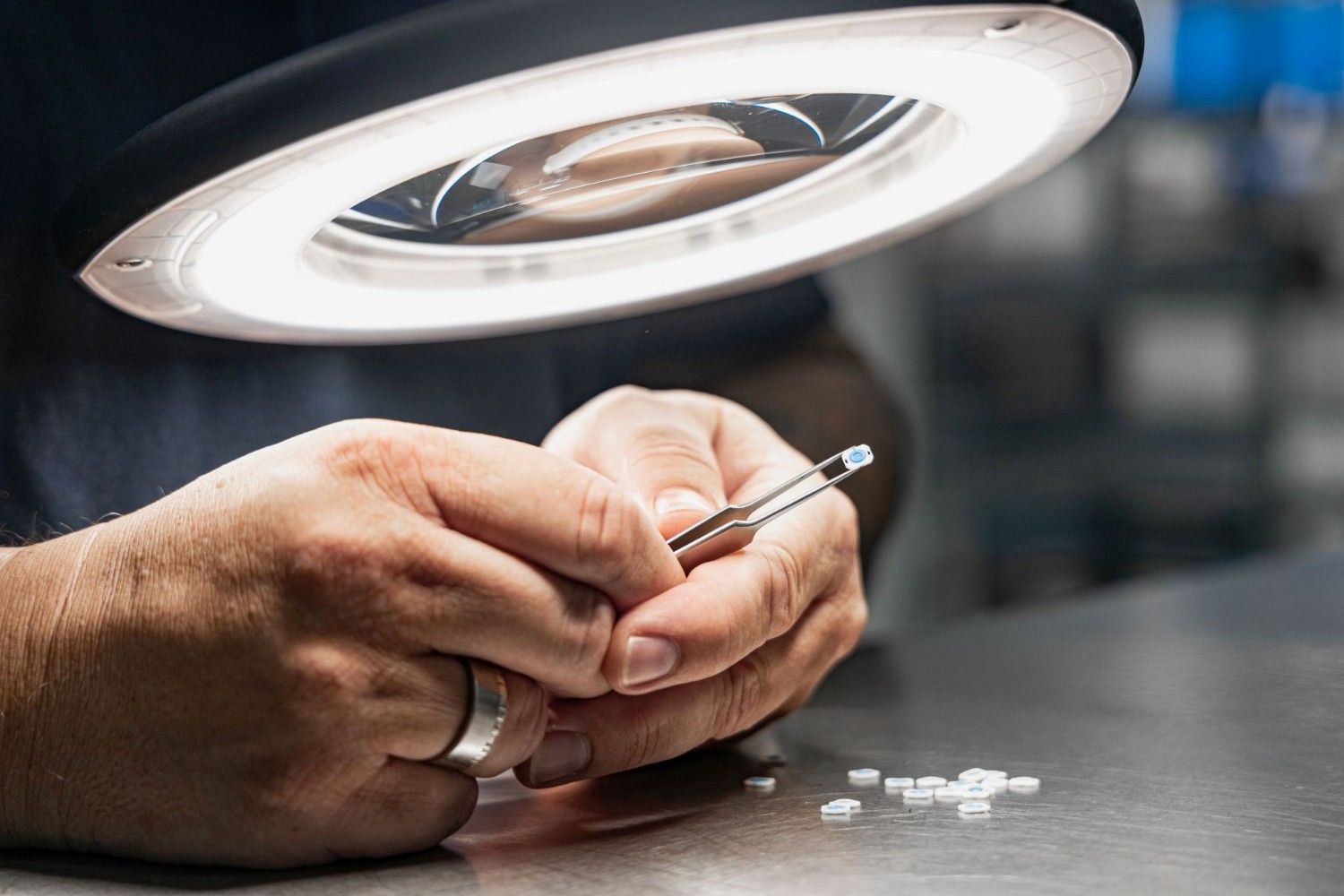
The two micro parts are packaged in transparent bags. Measuring 0.7 x 0.4 mm, the O-ring by itself is too small to pick it up with our fingers. It is a prime example of the precision of mass-produced micro components.
By direct comparison with the O-ring, the hearing aid component measuring 6 by 5 by 1 mm looks almost large, but it impresses viewers by its design. It is a two-component part. At its center, there is a membrane consisting of blue-colored liquid silicone (LSR), which is surrounded by a robust thermoplastic frame made of PBT, which facilitates the assembly inside the hearing device. The application determines the size of the part.

Extremely accurate and stable regulation
This particular hearing aid component was produced inside a single-cavity mold on an all- electric MicroPower injection molding machine. “For industrial mass production, we stop at four cavities”, explains Kreuzmayr. 16 cavities would already be too many, since wherever highest precision is required on the sub-millimeter level, it is important to have the cavities arranged very closely together. The main challenge in producing the hearing aid components are the narrow tolerances in the area of the corrugation on the membrane body. “Here we must be able to rely on the injection molding machine’s control accuracy, for in contrast to injection molding of larger parts, the remnant melt cushion plays no part here”, emphasizes Günter Polt, Application Engineer in starlim’s micro injection molding department. Polt has been working in the area of silicone injection molding for almost 30 years. When he moved to the micro molding department several years ago, “it was quite a shock”, he confides to us with a wink. “You cannot judge the quality of the parts with the naked eye. That is often only possible under a microscope.”

“The MicroPower machines recommend themselves by their extraordinary precision in the execution of all parameter settings”, points out Kreuzmayr. “This extremely sensitive dynamism combined with absolutely stable and accurate regulation is setting new benchmarks. Here, people are really re-thinking their standards of process reliability and repeatability.”
In the case of these hearing aid components, the high impression accuracy is not only decisive for efficient assembly. In this application, high precision is much more important for accurate sound reproduction. The tolerance margins for the finished two-component part are plus/minus two micrometers. This requires a very precise adjustment and control of the clamping force, as well as a very precise mold.
Integrated quality control
The mold comes from the in-house mold-making shop, where the roots of the now globally successful group of companies lie. In1974, Franz Sterner founded the mold-making business Sterner Werkzeugbau GmbH (formerly Franz Sterner GesmbH). Ten years later, the company Starlim Spritzguss GmbH (formerly Starlim Gummi- und Kunststoffverarbeitung GmbH) was established. These two business segments have long since become an inseparable entity. Molds are now being made exclusively for the company’s own production.
A big advantage for the customers – they get coordinated solutions from a single source and benefit from the knowledge transfer and integrated development. Only new laser technologies and micro-3D printing make it possible to construct molds for such tiny hearing aid components with so stringent acoustic quality standards.
For mass production it is planned to test the vibrational properties of the membrane in-line, that is directly following injection molding, still inside the cavity. This is the most efficient way, since there the extremely tiny parts are still in a defined position and need not be realigned for the quality check. For the vibration test, the mold-makers have integrated a sound emitter and a laser measurement system inside the robot gripper. “With this hearing aid component, we have achieved a real break-through, thanks to innovative mold technology and extremely efficient processing technology”, says Kreuzmayr.
Compact on two square meters of production floor
The integration of further production steps such as quality control is extremely well supported by the MicroPower’s design concept. On a floor space of just two square meters, the all-electric work cell fits in the entire equipment, including the clamping unit with a rotary plate, the patented two-step injection system, plus materials handling, automation, a temperature controller, the quality control system, and further process units. All of this while still keeping the mold space with a 400 mm distance between platens easily accessible. Linear guides ensure highly sensitive mold protection, and thanks to a high-precision 5-point toggle lever system, the clamping force is very evenly distributed across the mold parting line. “The machine’s design enables us to move the injection plunger right up to the mold parting line”, is how Jochen Sassmann, Regional Sales Manager of the WITTMANN Group and cooperating closely with starlim’s micro molding team, describes yet another feature contributing to high processing efficiency. It significantly reduces the sprue in size or even eliminates it altogether. Since fully vulcanized LSR cannot be recycled, silicone injection molding reaps the greatest benefit from this material-saving process.
Making the most of what the machines have to offer
15 years have gone by since starlim established its micro molding department. Then, the first micro molding machine from Battenfeld quickly arrived on its production floor. “At that time, Battenfeld was the only company able to supply micro machines for industrial mass production”, Kreuzmayr states. “The machine concept was continuously further developed and today defines the state of the art in micro injection molding in terms of precision and efficiency”, says Sassmann. With the MicroPower injection molding machine, the WITTMANN Group, of which Battenfeld is a part, still holds a unique selling point today.

Several MicroPower injection molding machines are currently operating at starlim in Marchtrenk, some inside the new clean room, where items such as high-precision products for eye surgery are being produced. Every one of these machines is tailored to fit the requirements for some special product group. There are some machines fully equipped for single-component injection molding, as well as two-component machines and one integrated system consisting of two individual machines connected to each other via a robot. The integrated system increases flexibility. It allows for the highly efficient production of two- component parts, but the two machines can also be utilized independently of one another
with single-component molds. In terms of automation, the MicroPower concept offers ample freedom. In addition to the vertically installed Scara robot, which is an integral part of the MicroPower production cell, various handling systems can be integrated via interfaces – including systems developed in-house by starlim.
Multi-component machine or integrated solution? – For each new project, the question of which production concept yields the higher overall efficiency is thoroughly investigated. The proportion of two-component products is currently about 40 per cent. The Micro Molding team at starlim is certain that this percentage will rise. Inquiries for two-component parts are already being launched more frequently now, but they also take up more time in product development.
Mass production, which originally tipped the balance towards cooperation with the WITTMANN Group in micro molding, still dominates the daily production scene in Marchtrenk to this day. Batch sizes in the millions are quite common. “MicroPower machines cope reliably with these extreme challenges and ensure a safe process for us”, says Dominik Kreuzmayr. In this context, starlim’s micro molding team also points to the good cooperation with the WITTMANN Group. “We communicate fast across short distances, and have so far found solutions for all challenges we have faced by putting our heads together. Thanks to our good partnership, we are really able to make the most of everything the machines have to offer in terms of technology.”
#wittmanngroup#SrichakraPolyplast#modernplasticsnetwork #printmagazine #printpublication #pinterest #modernplasticsglobal #modernplasticsindia #modernplasticscanada